Can ChatGPT or Claude build your prospect list?
· The Saleshunt Team
For one company, often yes. Ask ChatGPT or Claude with web search whether a firm publishes a sustainability report, and you'll usually get a good answer with a link. A prospect list is a different job. You need every company in your market, the same question checked for each one, a source for every answer, an honest gap where there is no answer, and the right person at each company today. That's the job Saleshunt was built for.
We use ChatGPT and Claude every day ourselves, so this piece is about where a chat stops when the thing you need is a list you can sell from.
What ChatGPT and Claude do well for sales
There are three things a chat assistant is genuinely good at in prospecting, and we'd recommend it for all of them.
- Working out who your ideal customer is. Talking it through out loud often surfaces the one fact that actually decides whether a company is a fit.
- Reading up on one company before a call. What they do, recent news, who runs it.
- A first draft of an email. Something to react to, rather than a blank page.
All three have one thing in common: they're about one company, or one idea, at a time.
We asked the same question both ways
To show the difference rather than argue it, we gave Claude one real prospecting question, the kind an ESG consultancy asks: manufacturers in Baden-Württemberg with 50 to 500 staff that publish a sustainability report but have no EcoVadis rating. Then we asked the same Claude again, this time with Saleshunt connected through our MCP.
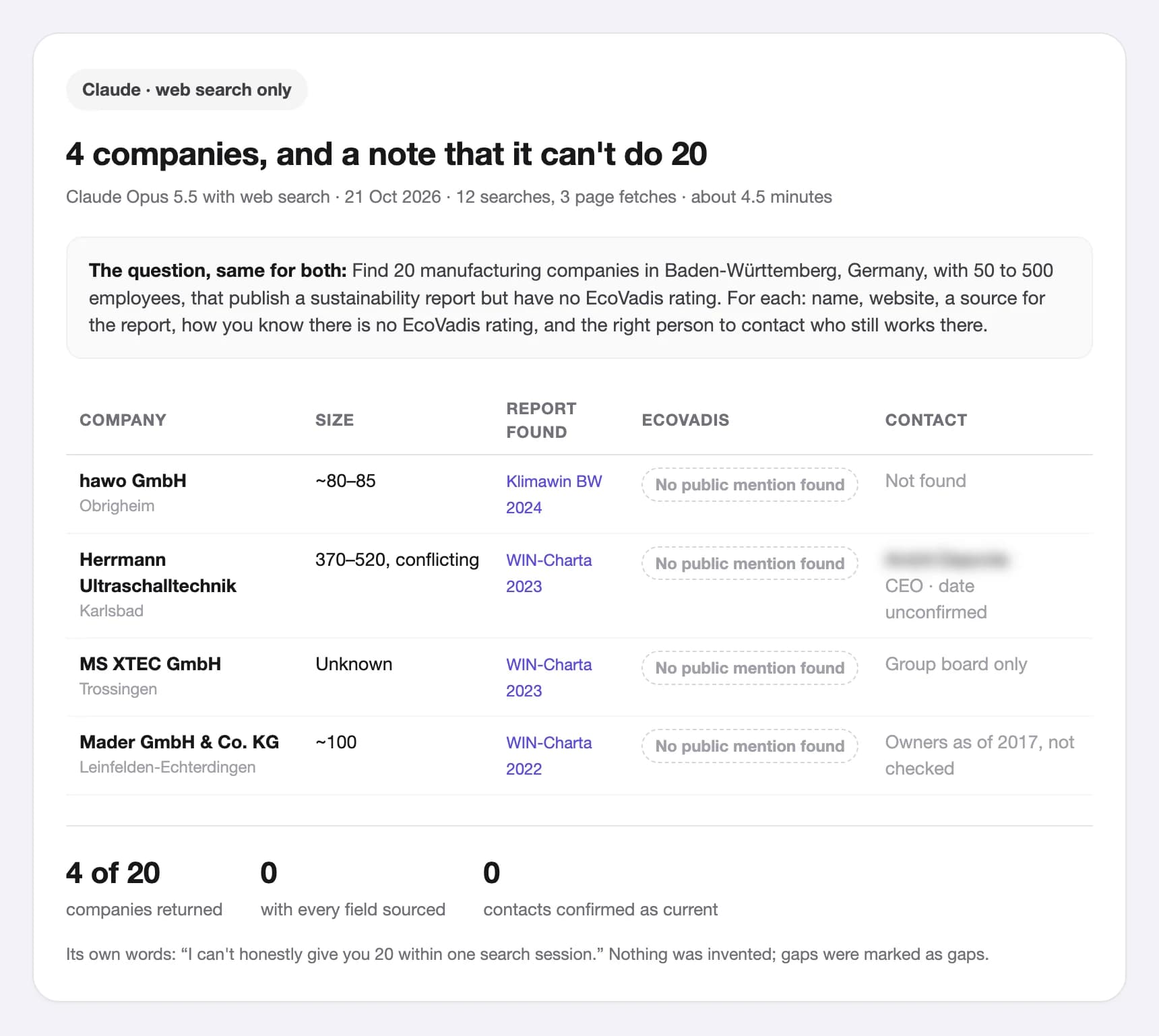
Claude on its own came back with 4 companies and an honest note that it couldn't do 20 in one session. It didn't make anything up. But no row had every field sourced, and none of the contacts was confirmed as still working there.
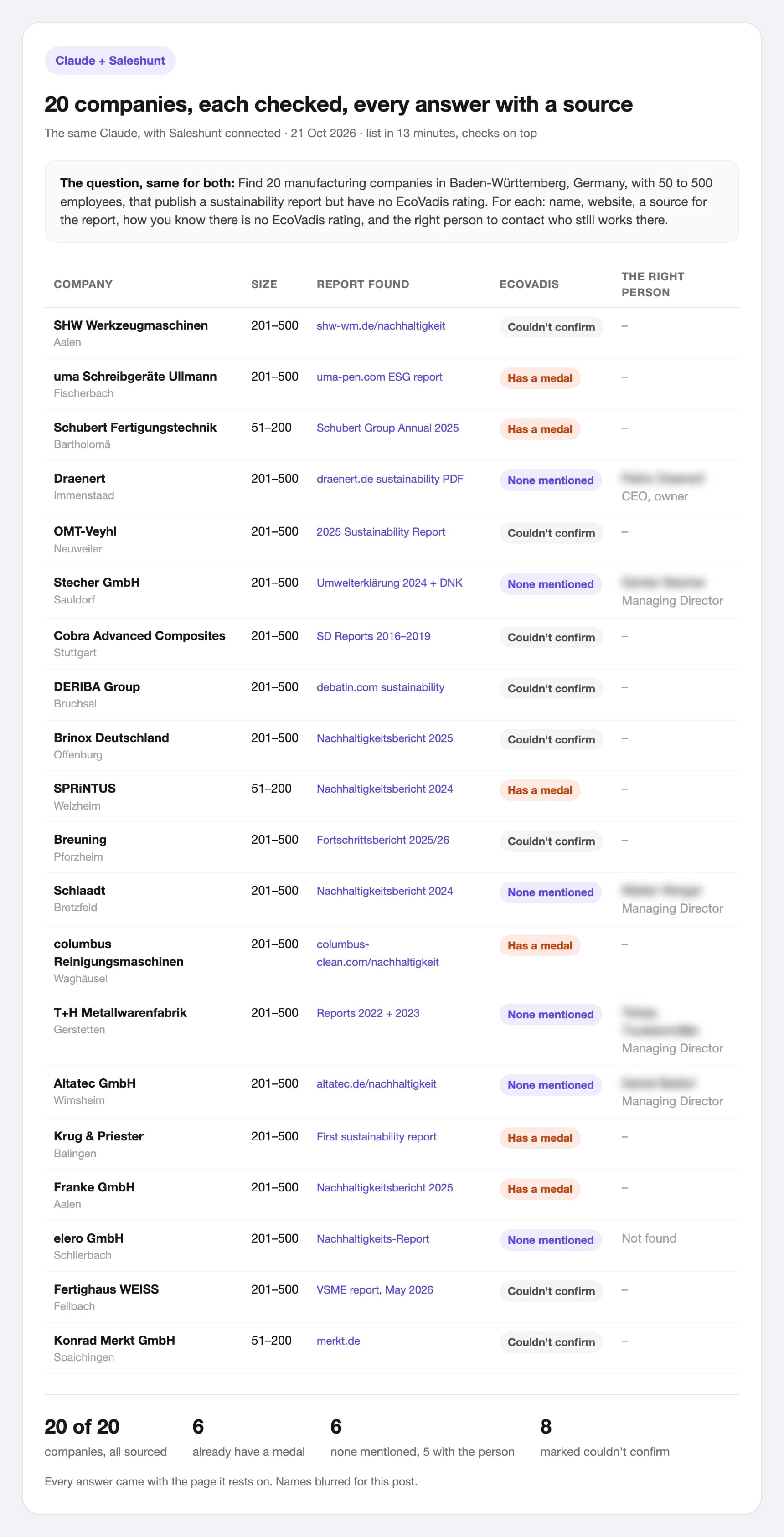
With Saleshunt connected, it delivered all 20 in 13 minutes, each checked against the question with a source for every answer. Then it asked every company the EcoVadis question on its own. Six already have a medal, so they aren't prospects at all. Six have no rating mentioned anywhere it looked. For five of those it found the right person, still working there, and for the sixth it said it couldn't. Eight it marked “couldn't confirm”, which is the honest answer for a rating companies don't have to publish. It took longer than the chat, and it ran in the background while we did something else.
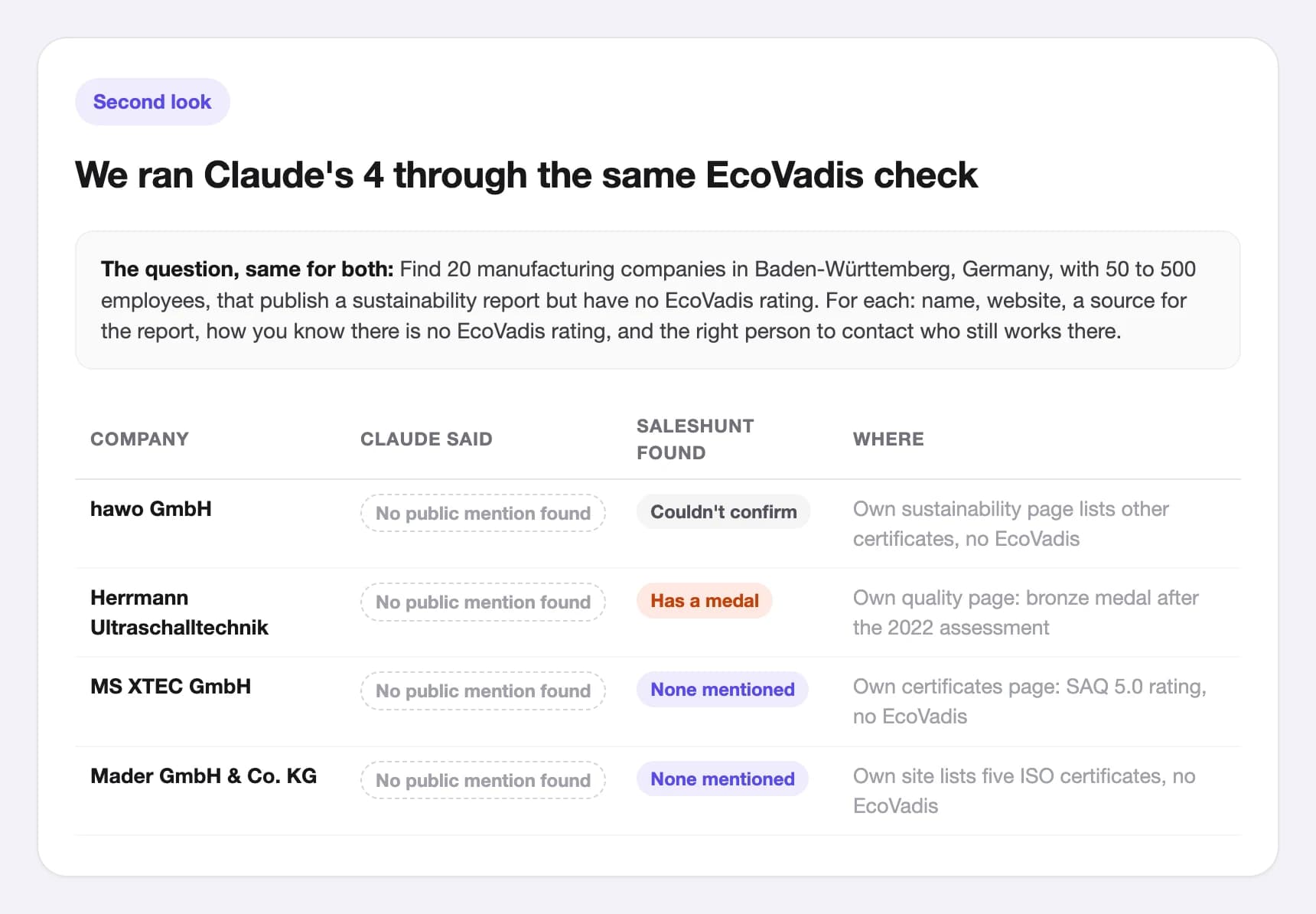
Then we checked Claude's four the same way. One of them has held an EcoVadis bronze medal since 2022, and says so on its own website. A list built from search results would have sent a pitch to a company that has already done the thing you're selling.
This isn't a story about one tool being careful and the other careless. Claude was careful. It's about how much one chat can check in a few minutes, and what changes when every company gets its own check.
Where a chat stops when you need a whole list
1. It answers your prompt, not your market
Ask for “companies in Germany that publish a sustainability report but have no EcoVadis rating” and you'll get a list. What you won't get is a sense of how big the real market is, so you can't tell whether you're looking at most of it or a tenth of it. In small, local and niche markets the companies are spread across LinkedIn, Google Maps and the open web, and plenty of them only show up in one of those places.
How Saleshunt handles it: it brings your market together from Google Maps, LinkedIn and the open web, then goes and looks at every company in it, one at a time. It's built in Europe, for European markets, so local company types and languages aren't an afterthought.
2. Company 1 and company 400 don't get the same care
A chat is at its best over a handful of rows. Chats have limits on how much they can write back, and long conversations lose the thread, so over hundreds of companies answers get shorter, rows get skipped or merged, and nothing tells you which ones were actually checked.
How Saleshunt handles it: every company is its own check against your question, done the same way each time. You can watch the list fill up, and every row that appears has already been checked against everything you asked for.
3. A guess and a found answer look the same
Language models are built to give an answer. When the information isn't out there, they can still produce something that sounds right, and in a chat it reads exactly like the answers that were found. For one company you can spot-check it. For four hundred you can't.
How Saleshunt handles it: every answer shows where it came from. When we couldn't find something, the cell says “we couldn't confirm this”. An empty cell with a reason is worth more than a confident guess, because you know exactly what to check before you reach out.
4. Near-misses end up on the list
Ask a chat for companies that match three criteria and you'll often get companies that match two. They look close enough on a quick read, which is the problem.
How Saleshunt handles it: every company is checked against each part of your question, and you get the best matches for what you asked, each with the reason it fits. The near-misses are checked too, they just don't crowd your list. We look at about three companies for every one we give you.
5. The contact who left last year
What the web knows about people is often a year or two behind. A name from a cached page is how an email ends up with someone who no longer works there.
How Saleshunt handles it: it finds the right person at each company when you ask, and checks they're still working there.
6. A chat ends. Your market doesn't.
Next month a new firm opens a second office, or a company you passed on starts hiring for exactly the role you sell to. A chat answers when you ask. It doesn't keep an eye on your market for you.
How Saleshunt handles it: it keeps watching your market on your criteria and tells you when a company becomes worth a call.
ChatGPT or Claude vs Saleshunt for prospecting
| ChatGPT or Claude with web search | Saleshunt | |
|---|---|---|
| One question about one company | Good | Good |
| How many companies | What fits in a reply | Hundreds or thousands, each looked at separately |
| Where it looks | Web search | LinkedIn, Google Maps and the open web, combined |
| Same check for every company | Not by default, long lists drift | Yes, one check per company |
| Source per answer | Sometimes | Every answer |
| When it can't find something | Can fill it with a guess | Says “we couldn't confirm this” |
| Near-misses | Can slip in | Checked and left out |
| The right person | From web pages, which can be out of date | Found when you ask, checked to still work there |
| After today | Answers when you ask again | Keeps watching on your criteria |
| Outreach | Drafts you copy and paste | Drafts for your approval, sent from your own mailbox |
So which one should you use?
Both. Use ChatGPT or Claude to think through who your customer is, to read up before a call, and to sharpen an email. Use Saleshunt when the question is which companies, all of them, and who do I talk to there. The line is between a conversation and a list where every answer shows its source and every gap is marked.