── Comparison
Saleshunt vs Apollo
Apollo and Saleshunt both help you find companies to sell to and the people to talk to there. Apollo filters a big contact database and wraps a sales platform around it. Saleshunt checks every company in your market against the question you ask. This page puts them side by side.
We make Saleshunt, so we've kept to facts either side could check. Apollo's details come from apollo.io, checked on 28 October 2026. Spotted something out of date? Tell us at support@saleshunt.ai and we'll fix it.
Apollo in one line
A contact database with a sales platform around it: filters, sequences, a dialer and deals in one tool.
Saleshunt in one line
Your best customers don't fit in a dropdown. Ask for them in your own words. Saleshunt checks every company in your market and brings back the best matches, with the right person at each.
| Topic | Apollo | Saleshunt |
|---|---|---|
| Built for | Sales teams running outbound at volume | Founders and owners who sell, without a sales-ops person |
| How you search | Filters on database fields, plus AI Research per record | Your question is the search, checked per company |
| Data sources | Apollo's own database, plus waterfall enrichment on paid plans | Google Maps, company websites and LinkedIn, combined |
| Source per answer | A database record | Every answer, with gaps marked |
| Contact data | 1 credit per email, 8 per phone number | Decision-maker found when you ask, checked on LinkedIn |
| Outreach | Sequences at volume, a dialer, mailbox buying | Drafts you approve, sent from your own mailbox |
| Monitoring | Saved searches, intent topics, website visitors | Signals in plain language, included on Pro during launch |
| Market focus | A global database | Built in Europe, for European markets |
| Pricing model | Per seat, with credits that expire each cycle | Per result, prepaid, or Pro at €99 a month |
| Free start | Free plan: 900 credits a year per seat | 25 companies free for 14 days, no card |
Filters, or your own question
Apollo
You pick from Apollo's filters: job title, seniority, industry, headcount, location and more, and get thousands of contacts in seconds. For a question no filter covers, AI Research can look into a record for one credit per run.
Saleshunt
You ask in your own words, for example: manufacturers that publish a sustainability report but have no EcoVadis rating. Every company is checked against each part of the question, and the best matches come back. Near-misses are checked too, but they don't crowd your list.
Where the data comes from
Apollo
Apollo's own database of companies and contacts. Paid plans add waterfall enrichment, which tries other providers when Apollo has nothing. A record is as current as its last update.
Saleshunt
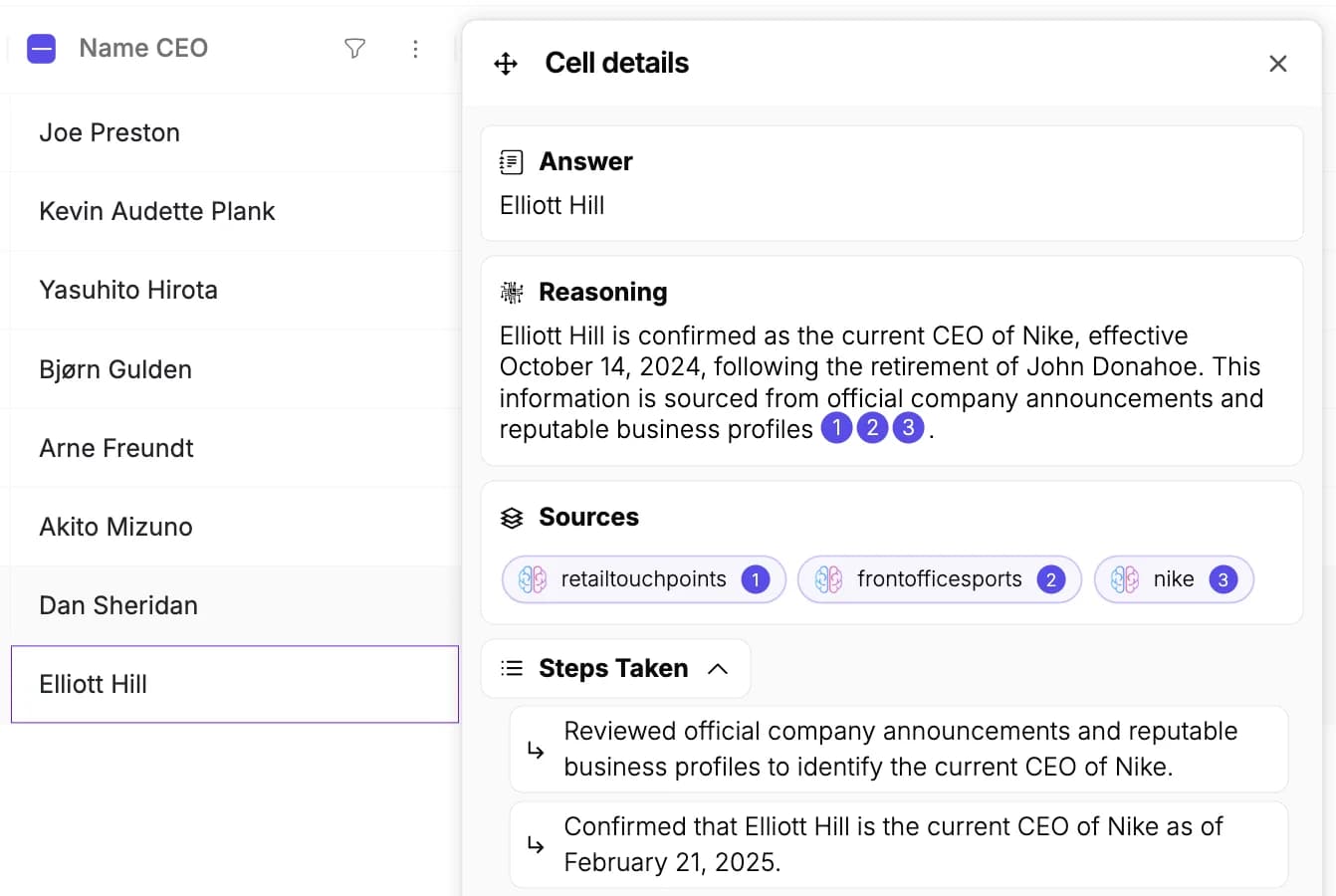
Google Maps, company websites and LinkedIn, combined and checked when you ask. Every answer shows its source, and when something can't be confirmed the cell says so.
Big markets, or small and local ones
Apollo
A global database, used by over 600,000 companies by Apollo's own count. Coverage is deepest where it holds the most records, so test it on a sample of your own market.
Saleshunt
Built in Europe, for European markets. Websites are read in their own language, and the local firm with a Google Maps listing and a two-person LinkedIn page gets looked at too.
Decision-makers and contact data
Apollo
Searching is free. Revealing an email costs 1 credit and a phone number 8, from Apollo's database or the providers in its waterfall.
Saleshunt
It finds the decision-maker at each company when you ask and checks on LinkedIn that they still work there, with a verified email. Phone numbers are extra: €0.34 each, charged only when found.
Outreach
Apollo
Built for volume: unlimited sequences on paid plans, a dialer, email warmup, and domain and mailbox buying for cold email. Search, outreach, calls and deals live in one tool.
Saleshunt
It drafts outreach from what it found about each company. On Pro, campaigns and sequences send from your own mailbox, and nothing goes out until you approve it.
Watching your market
Apollo
Saved searches, intent topics (six on Basic and Professional) and identifying companies that visit your website.
Saleshunt
Signals you describe in plain language, for example a company starting to fit your criteria. Included on Pro during launch, or €0.05 per signal check on pay as you go.
Pricing
Apollo
Per seat. Free, then Basic at $49, Professional at $79 and Organization at $119 per seat a month, billed annually (Organization needs three seats). Each seat comes with credits, and unused credits expire at the end of the billing cycle. See apollo.io/pricing for current prices.
Saleshunt
No seats. Pay per result from a prepaid balance that never expires: €0.15 for each company that matches your criteria, or €0.34 for a full contact with the decision-maker and a verified email. Or Pro at €99 a month with 150 included. See pricing.
Which one fits you
Apollo is likely the better fit if
- your ideal customer fits in standard filters: title, industry, headcount
- you want search, sequences, calls and deals in one tool
- you sell to larger companies at volume
- you want a free plan with no end date
Saleshunt is likely the better fit if
- what makes a company a fit isn't a field in any database
- you sell into European markets with many small, local companies
- you'd rather pay per match than per seat
- nobody on your team has time to run a sales platform
They also work together: Saleshunt to find and check the companies that fit, Apollo for sequences at volume afterwards.
Test it on your own market
The fairest comparison is your own question. Start with 25 companies free, no card.
Frequently asked questions
Is Saleshunt an Apollo alternative?
For finding the companies that fit and the right person at each, yes, especially when your criteria go beyond job title, industry and headcount. If you rely on Apollo mainly for high-volume sequences and calling, Saleshunt does a different part of the job.
How well does Apollo cover European companies?
It depends on the market. A large database is deepest where it holds the most records, so test it on a sample of your own market first. Saleshunt checks each company when you ask and shows a source for every answer, and when something can't be confirmed, it says so.
How do the prices compare?
They charge for different things. Apollo charges per seat each month, with credits for emails, phone numbers and data that expire each billing cycle. Saleshunt has no seats: €0.15 for each company that matches your criteria, €0.34 for a full contact, or Pro at €99 a month. Top-ups never expire.
Can Saleshunt answer questions Apollo's filters can't?
Yes, that's what it's built for. Apollo's AI Research can look into a single record for a credit. In Saleshunt the question itself is the search: you ask in plain words and every company in your market is checked against it, with a source per answer.
Does Saleshunt send emails on its own?
No. It drafts outreach from what it found, and nothing goes out until you approve it, from your own mailbox.
Apollo's plans and features as published on apollo.io, checked on 28 October 2026. Plans change, so check apollo.io before you decide. Apollo is a trademark of its owner; this page isn't affiliated with or endorsed by Apollo.