── Comparison
Saleshunt vs Clay
Clay and Saleshunt both help you find companies to sell to and the people to talk to there. They go about it very differently, and each fits a different kind of team. This page puts them side by side.
We make Saleshunt, so we've kept to facts either side could check. Clay's details come from clay.com, checked on 21 October 2026. Spotted something out of date? Tell us at support@saleshunt.ai and we'll fix it.
Clay in one line
A GTM data platform: 150+ data providers, AI agents and tables you build into your own workflows.
Saleshunt in one line
Your best customers don't fit in a dropdown. Ask for them in your own words. Saleshunt checks every company in your market and brings back the best matches, with the right person at each.
| Topic | Clay | Saleshunt |
|---|---|---|
| Built for | GTM engineers and ops teams | Founders and owners who sell, without a sales-ops person |
| How you start | Build a table: sources, enrichment columns, AI prompts | Type who you're looking for, in your own words |
| Data sources | 150+ data providers, or your own API keys | Google Maps, company websites and LinkedIn, combined |
| Custom questions | AI columns (Claygent) you write and place | Your question is the search, checked per company |
| Contact data | Waterfall across many providers | Decision-maker found when you ask, checked on LinkedIn |
| CRM sync and webhooks | Yes, on Growth and Enterprise | Import and export; custom integrations on Enterprise |
| Monitoring | Signals from the Launch plan up | Signals in plain language, included on Pro during launch |
| Market focus | Global, depends on the providers called | Built in Europe, for European markets |
| Pricing model | Data Credits plus Actions, monthly plans | Per result, prepaid, or Pro at €99 a month |
| Free start | Free plan: 500 Actions and 100 Data Credits a month | 25 companies free for 14 days, no card |
Who it's built for
Clay
Teams with a GTM engineer or an ops person who enjoys building workflows. Clay describes itself as the platform GTM engineers build on, and it rewards the time someone puts into it.
Saleshunt
Founders and owner-run firms that sell themselves and have nobody to set up sales tooling. The work is done for you once you've said who you're looking for.
How you start
Clay
You build a table: choose where companies come from, add enrichment columns and AI prompts, and set the order they run in. Once it's built, the whole team can reuse it.
Saleshunt
You type who you're looking for in one box, in your own words, for example: accountancy firms in Utrecht with more than one office that publish a sustainability report. There's nothing to configure first.
Clay
- 1Pick the sources
- 2Add enrichment columns
- 3Write the AI prompts
- 4Set the order and run
Built once, then the whole team reuses it
Saleshunt
- 1Say who you're looking for
- 2Every company gets checked
- 3Best matches, with the right person
Nothing to set up first
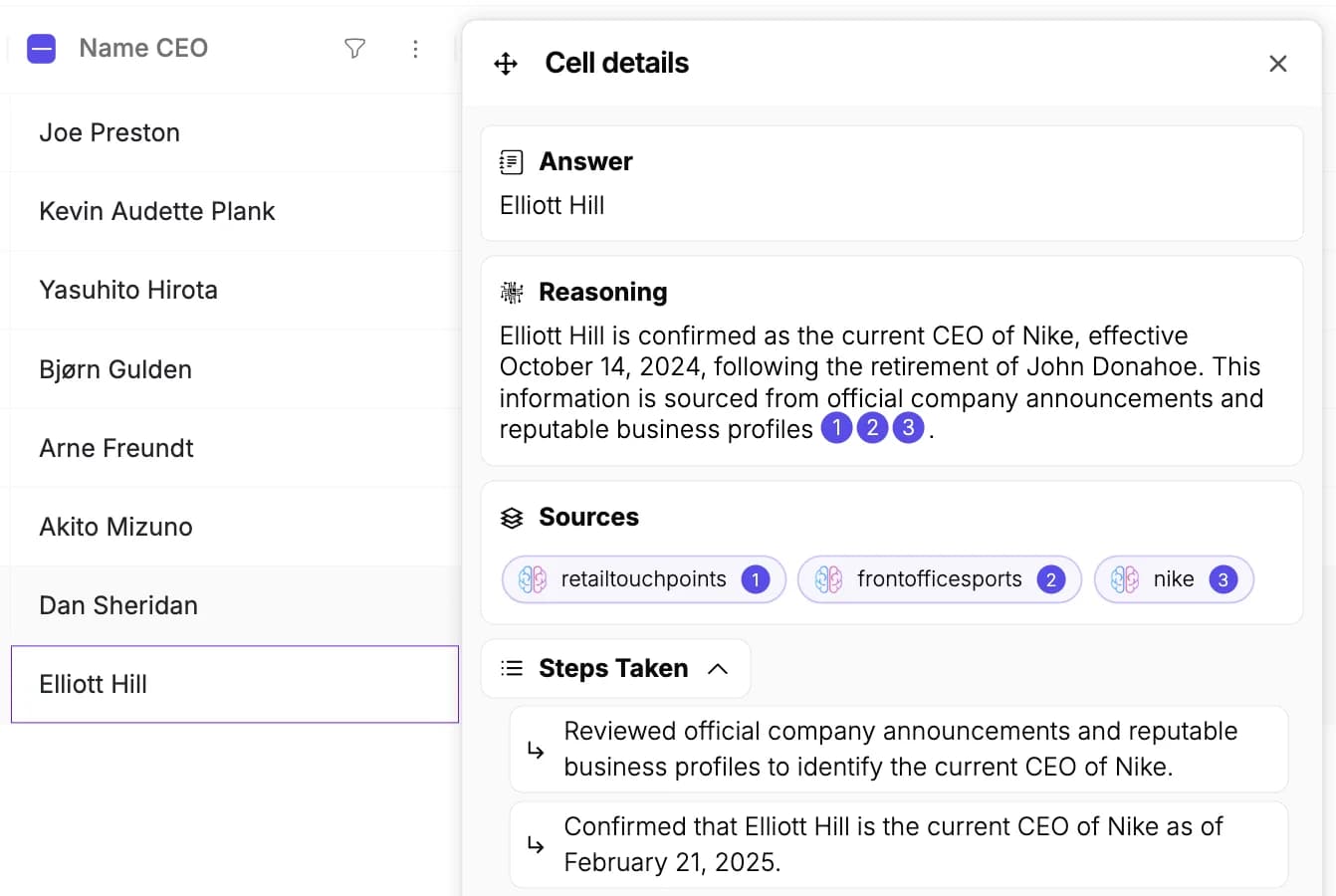
Asking your own question about each company
Clay
Claygent, Clay's AI agent, can look up almost anything about a company. Someone writes the prompt and decides where in the table it runs.
Saleshunt
Your question is the search. Every company is checked against each of your criteria, each answer shows its source and reasoning, and when something can't be confirmed the cell says so.
Where the data comes from
Clay
A marketplace of 150+ data providers, combined in waterfalls: when one provider has nothing, the next one tries. You can also bring your own provider API keys.
Saleshunt
Google Maps, company websites and LinkedIn, combined and read in the local language. That suits small and local firms that many databases list thinly.
Decision-makers and contact data
Clay
Contact data comes through the providers in your waterfall, which gives strong coverage at volume. How current it is depends on those providers.
Saleshunt
It finds the decision-maker at each company when you ask and checks on LinkedIn that they still work there, with a verified email. A phone number costs €0.34 and is charged only when found.
Integrations and automation
Clay
CRM sync and webhooks on the Growth and Enterprise plans, HTTP API calls inside workflows, and an MCP server for using Clay from ChatGPT or Claude. This is where Clay does a lot more.
Saleshunt
Import and export your lists. On Pro, campaigns and sequences send from your own mailbox after you approve each draft. Custom integrations on Enterprise.
Watching your market
Clay
Signals for job changes, company news and social activity from the Launch plan up. Web intent signals on Growth and Enterprise.
Saleshunt
Signals you describe in plain language, for example a company starting to fit your criteria. Included on Pro during launch, or €0.05 per signal check on pay as you go.
Pricing
Clay
Two kinds of credit since March 2026: Data Credits for data and AI bought from providers, and Actions for each step a workflow runs. Plans are Free, Launch, Growth and Enterprise, billed monthly or yearly. See clay.com/pricing for current prices.
Saleshunt
Pay per result from a prepaid balance that never expires: €0.15 for each company that matches your criteria, then a set price per lookup. Or Pro at €99 a month. See pricing.
Which one fits you
Clay is likely the better fit if
- someone on your team builds and maintains workflows
- you need enrichment synced into your CRM automatically
- you want many providers' contact data at volume
- you want a free plan with no end date
Saleshunt is likely the better fit if
- nobody on your team has time to build workflows
- your best customers are defined by something no database field holds
- you sell into European markets with many small, local companies
- you want to pay per result rather than per workflow step
They also work together: Saleshunt to find and check the companies that fit, Clay for the CRM plumbing afterwards.
Test it on your own market
The fairest comparison is your own question. Start with 25 companies free, no card.
Frequently asked questions
Is Saleshunt a Clay alternative?
For finding the companies that fit your own criteria and the right person at each, yes. For multi-provider enrichment workflows, CRM sync and automation, Clay does more. Some teams use both: Saleshunt to find and check the companies, Clay for what happens afterwards.
Which one is easier to start with?
Saleshunt starts from one sentence and needs no setup. Clay is built to be configured, so it pays off most when someone on the team enjoys building workflows.
How do the prices compare?
They charge for different things. Clay charges Data Credits for provider data and Actions for each workflow step, inside a monthly plan. Saleshunt charges per result: €0.15 for each company that matches your criteria, then a set price per lookup, or Pro at €99 a month.
Which one is better for European markets?
Clay's coverage depends on the providers it calls. Saleshunt is built in Europe, for European markets, and combines Google Maps, company websites and LinkedIn for small and local firms. Both have a free start, so the fairest test is to try each on your own market.
Clay's plans and features as published on clay.com, checked on 21 October 2026. Plans change, so check clay.com before you decide. Clay is a trademark of its owner; this page isn't affiliated with or endorsed by Clay.